Calligraphic Meditations
For me, it is more like an expression coming out of meditation.
At first there is only reciting or chanting the wazifa. I try not to expect anything.
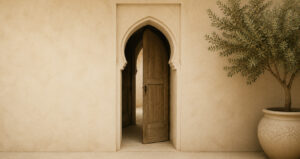
Door
But if the longing to see the letters is there I will think of the written form during the day and before going to sleep. If needed I will consult one of the wazifa manuals to check the original Arabic as the Latin script is not always clear: Arabic has several signs for t, d, s, h, etc. with varying pronunciations.
Then hopefully something happens after a few days and I may get the feeling that a certain form wants to reveal itself. That something from within wants to come out.
I may get the feeling that a certain form wants to reveal itself – that something from within wants to come out.
No holding back
When I can no longer hold back I draw a little diagram, a small sort of design, sometimes simply with a ballpoint.
Then the writing starts and I will search, try, and waste like 40 sheets of costly paper. Only special satinized glossy paper will do, not the paper used in western calligraphy as it would be too dry: it would absorb the ink too quickly where one needs more time. In the past calligraphers rubbed their paper until it was smooth with a precious stone or a shell. Nowadays the copyshop can provide, but the paper must not be too glossy as it will need to be able to absorb the ink after a while. I cut my own pen from bamboo which is very difficult, it needs to fit your hand and is very personal. My old Bahai calligraphy teacher taught me all that. During my searching and practising my whole room will be strewn with sheets of paper. For ink I only use Chinese writing ink, I love the black color with all its shades and I particularly like the structure of the ink. My teacher preferred brown ink cooked from walnut shells.
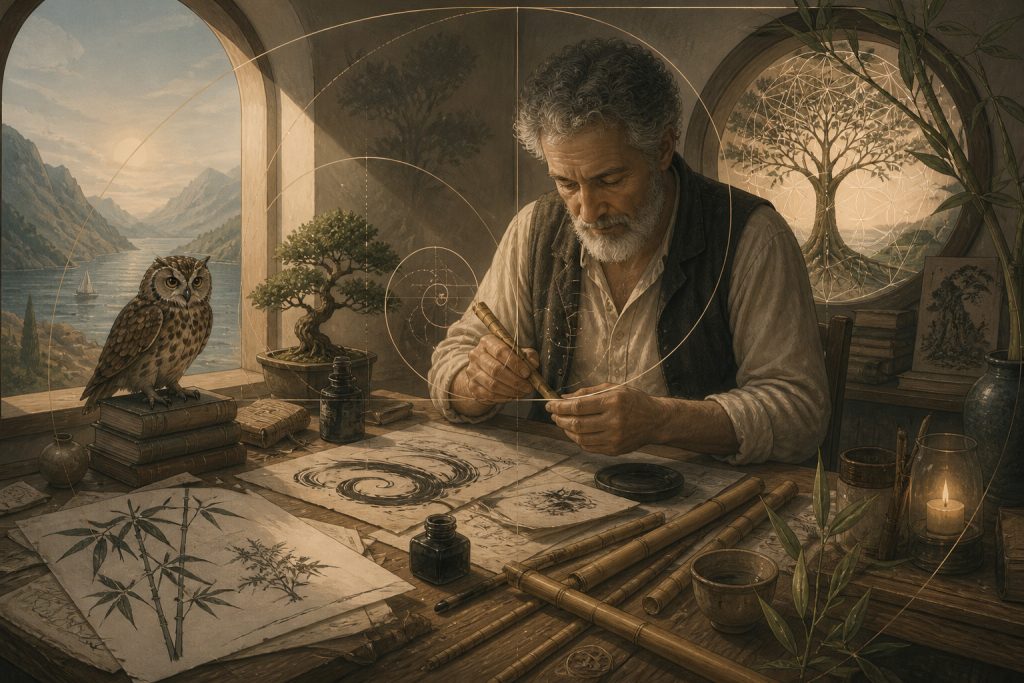
I continue untill the form arises. Then I will put it on the door of my study as a concept and I will continue to make more until it comes through more balanced. It is intuitive and you will know when to stop. After the concept has come through I need to focus on the breath. The breathing exercises from our Sufi tradition have helped me with this. If the breath is calm you can make a stroke with the pen while breathing out. In this way I hope to arrive at a final version.
Then I will leave my room and come back after some hours or the next day.
If the calligraphy has reached its final form I will know as I am staring at something that is not really mine, that I am looking at a visual form that I did not create or conceived. It should make me silent, no thoughts and this is where I can return to the wazifa meditation: receiving a meaning beyond the literal meaning of the word.
Finding my own way
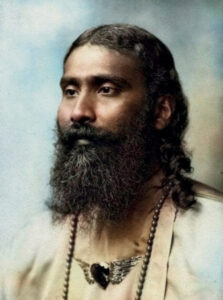
I consider my calligraphies not to be art as in the East the art of calligraphy is bound by strict conventions. My writing is in a free style and is outside this convention. For me it is more like an expression coming out of meditation. My Bahai teacher tried to teach me the Persian Nastaliq convention and also practised writing the Holy Name in his tradition. But he sent me away to find my own way somehow as it was also clear to him that I was drawn more to Arabic and more drawn to Sufism than to the Bahai faith. Some years later I found Hazrat Inayat Khan and the Wazifa tradition he brought with him to the West.
It should make me silent, with no thoughts. This is where I can return to the wazifa meditation: receiving a meaning beyond the literal meaning of the word.
Share this article
In this edition