“Work with your hands, get dirty, remain close to the Earth and create communities, because we cannot do this alone..“
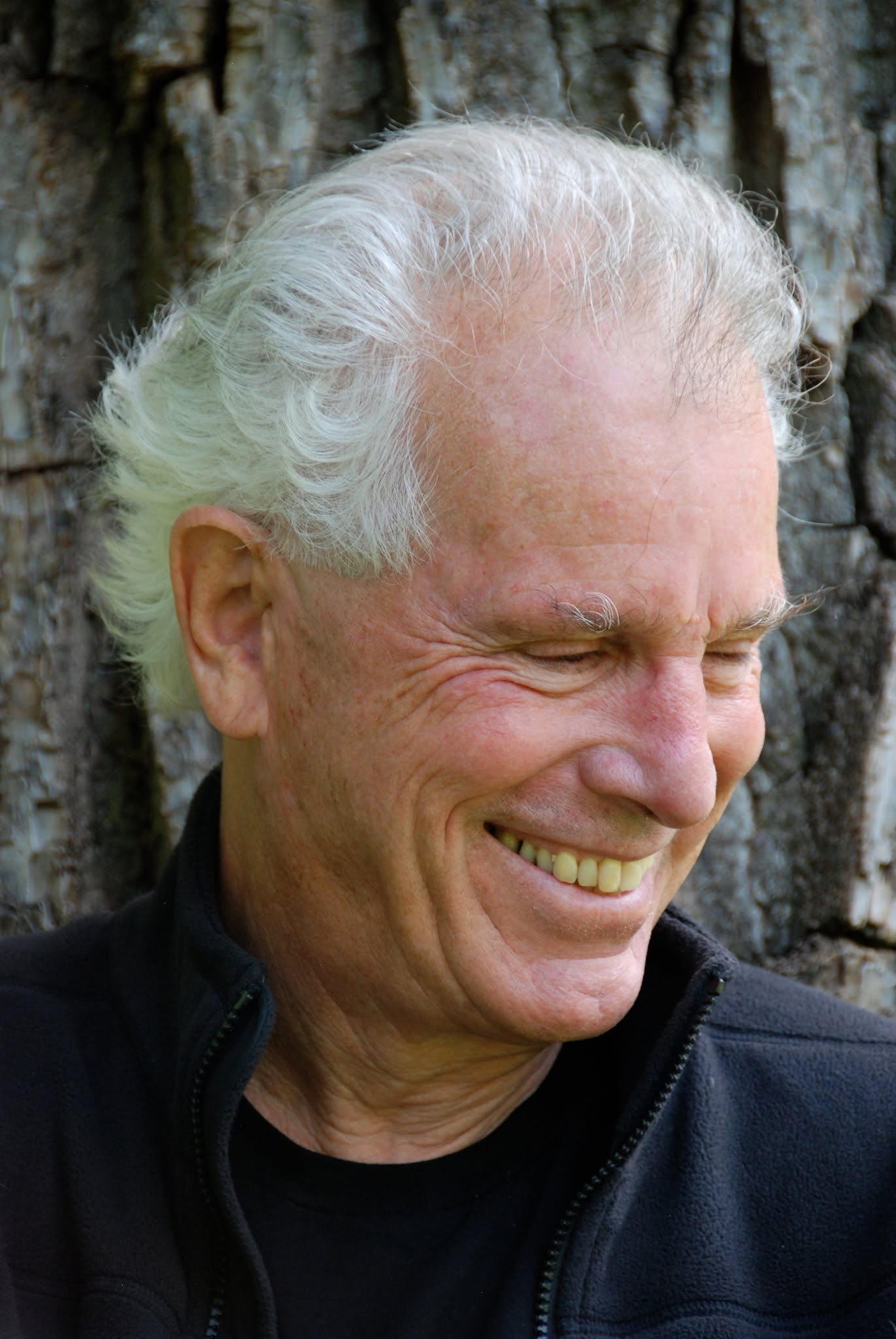
What does it mean to live with confidence, openness and attention in this uncertain time? In this interview, Elias Amidon talks about non-duality, universal Sufism and the space that arises when we do not have to capture or control everything.
From his long experience within the Sufi Way, he tells how different spiritual traditions can meet without losing their uniqueness. He also speaks of God as a poetic language for the great mystery, of the power of surrender and of the need to look not only at the crises of our time, but also at the kindness, creativity and connectedness that are constantly there.
His message to young people is simple and at the same time demanding: have faith, relax, discover your own voice and stay close to what really lives.
Door
↠
Non-duality and Sufism
How did you arrive at the idea of Advaita/non-duality?
I came to it through Sufism. The central phrase of our tradition is ‘Toward the One’. What is the One other than non-dual: not two? Yet, as in Buddhism, moving toward the One does not mean abandoning the many. We are citizens of the many and part of the many. At the same time, the One holds us; it is our vast home, embracing all things, all forms and all beings.
My understanding of non-duality, or Advaita, grew out of a long study of Sufism. I was fortunate to encounter the Western Sufism of Inayat Khan, which is inclusive of all cultures and viewpoints. Becoming a Sufi did not mean that I could accept only specifically Sufi ideas. The Sufi Way is wide open. I could study Vedanta, Advaita Vedanta, Dzogchen, Buddhism and Christian mysticism, because all of them could be included.
That is the beauty of this path of Universal Sufism: it holds different traditions in an embrace without trying to combine them into a single dogma. We can appreciate these beautiful forms of human expression, whether they are Buddhist, Islamic, Christian or Jewish. I remember a beautiful saying of Inayat Khan: human beings are not meant to agree; they are meant to create beauty. That touched me deeply.
We do not have to agree about everything. Our differences allow us to exchange ideas and understand one another. I may not agree with all the metaphysical ideas found in Christian mysticism, for example, but when I read a Christian mystic, I allow that vision to be true on its own terms. For a while, I enter it. I may translate it into my own metaphysical language, but I can still appreciate why the mystic sees reality in that way.
The idea of God
Contrary to Buddhism, Sufis embrace the idea of God and yet know that in principle there is Only One. How do you look at this?
For us, it is poetry. Sufis love romantic language, but we can also understand it metaphorically. ‘Toward the One’ is itself a metaphor. When I say the words, I feel something opening within me. We need language, and therefore we need names, but the name is not the reality itself. If we look closely at Buddhism, we also find many sacred figures, and even the Buddha can become a devotional figure. It seems to be a human tendency to personify or deify what we wish to understand. Human beings often need some form they can grasp. For me, however, the inclusive nature of the Sufi Way offers freedom.
The language of God also gives us the possibility of writing love poetry. We may address ‘Thou’, while knowing that Thou is not truly other. A simple prayer says: ‘Show me the way forward.’ It does not even need to say, ‘Lord, show me.’ Who or what are we asking? We might call it God, the great heart of things, or the spirit of guidance.
When you connect your own heart with that greater reality and sincerely ask, ‘Show me the way,’ you open yourself. There is surrender in those words: I do not know the way; show me. There is also faith in them, and that is beautiful.
Concern for the World
Many young people are deeply concerned about the state of the world and their future. What would you say to them?
I would begin by advising them to be very cautious about what stories to believe about the world. Everything may appear to be deteriorating: there is violence, ecological destruction, climate change, artificial intelligence, social polarisation, disinformation and the harmful influence of social media on young people’s ability to connect. When we gather all these problems into a single picture, the result can seem overwhelming and dark.
We should remember, however, that this picture is also a story we have constructed and begun to regard as the whole of reality. The difficulties and conflicts are real, but they are only one aspect of the great drama of life on Earth. When two people are peacefully sitting together in a room, that entire threatening story is not present in that moment.
We don’t have to agree on everything. Our differences allow us to exchange ideas and learn to understand each other.
In daily life, when I go to the shops, talk with friends or meet strangers who have nothing to do with Sufism, I encounter a great deal of kindness. Even people with whom I disagree politically generally want to be kind and understanding. Although hostility certainly exists, I believe that the greater part of human culture is sustained by kindness.
Consider the way Islamic terrorism has coloured perceptions of Arab and Muslim cultures. I have travelled in many such countries, and my overriding experience has been one of hospitality, kindness and curiosity. I once spoke about Sufism in a mosque in Damascus before four thousand people. I was an American, and the audience knew it, yet they received me warmly. A terrorist attack committed by a few radicalised young people becomes headline news, while the peaceful lives of millions of Muslims do not. The resulting picture is distorted.
The same distortion applies to the younger generation. In the Netherlands for instance, many young people are developing creative initiatives to change the world: recycling coffee grounds to grow mushrooms, reusing old jeans to produce paving materials, and experimenting with regenerative agriculture and ecologically sustainable ways of living. These developments rarely receive the same attention as bad news.
We need to allow differences and remain open. Openness does not mean having no beliefs, convictions or deep feelings. On the contrary, it means meeting life with an open heart and an open mind.
If a peaceful world is our great wish, we must ask what peace requires in our own lives. It asks us to be kind and forgiving, to practice patience and to handle our opinions carefully. We should resist the urge to make everyone accept our own point of view as the only correct one.
What kind of attitude could be helpful?
The first thing I would say is: have faith. I do not mean faith in a doctrine or a religious institution, but confidence that, at the deepest level, all is well. You have been given the creativity, strength and vitality you need to become a force for light in the world. Notice where your interest and talents lie, use them and follow them.
Yet young people may still ask where to begin and how to recognize their talents when they feel confused. My first advice is to relax. Relaxation does not mean collapsing or becoming passive. You can be alert, energetic and active. It means relaxing the inner tension: the insistence on your own stories, viewpoints, opinions and conclusions.
As that tension softens, your innate creativity, interests and abilities can unfold naturally. You may be a trumpet player, a sign painter or a schoolteacher. There is not necessarily one great goal that you must discover. You may have several careers; I certainly did. That was my path, although it need not be everyone’s path.
This relaxation reaches deeply into the way the ego was formed and into the fears we developed early in life. All of us have known fear in this uncertain world. We do not know what will happen tomorrow, next year or ten years from now. We can learn to relax into that uncertainty. This involves surrendering the demand to know and control everything.
‘To thine own self be true’ means being a genuine person and being present. We can be present only by opening to the present moment. ‘Relax’ may not be the perfect word; perhaps ‘open’ or ‘surrender’ is better. Relaxation, surrender and humility belong together.
Young people often imagine themselves to be the centre of the universe and assume that they know better than older people. That self can resemble a bird strutting about and displaying its plumage. There may be a time for such display, but we should recognise that it is also a costume. We can take it off. Our true self is already beautiful and is waiting to express itself creatively in the present moment.
Whether you work for a company, become a parent, teach at a school or fly aeroplanes, creativity and the joy of living are always found in the present. A bird sings its own song rather than imitating another. In the same way, we must relax sufficiently to discover our own voice and our own tune. Human beings are less restricted than birds: we have many songs and many talents. A person can be both a poet and a painter, or both a mother and a doctor.
Of je nu voor een bedrijf werkt, ouder wordt, op een school lesgeeft of vliegtuigen bestuurt, creativiteit en levensvreugde zijn altijd in het heden te vinden. Een vogel zingt zijn eigen lied in plaats van een andere vogel na te bootsen. Zo moeten ook wij ons voldoende ontspannen om onze eigen stem en melodie te ontdekken. Mensen zijn minder beperkt dan vogels: wij hebben vele liederen en vele talenten. Iemand kan zowel dichter als schilder zijn, of zowel moeder als arts.
Climate change and other challenges
What encouragement would you offer younger people?
I would wish them courage, faith and hope. The present situation is precarious, but earlier generations also faced very difficult times. Imagine living in 1938; it too would have seemed as though the world were collapsing. Or consider the An Lushan Rebellion in eighth-century China, when an immense part of the population died. The difference today is that news from the entire world reaches us constantly through our phones, which makes every crisis feel immediate and intense.
Climate change and the other challenges before us are enormous. Yet by coming together, we will be able to do things that we cannot presently imagine. The Earth is in a transitional state, moving from one way of life into another. Such a transition also involves the breakdown of existing economic, political and ecological systems. We have to pass through it with courage and endurance.
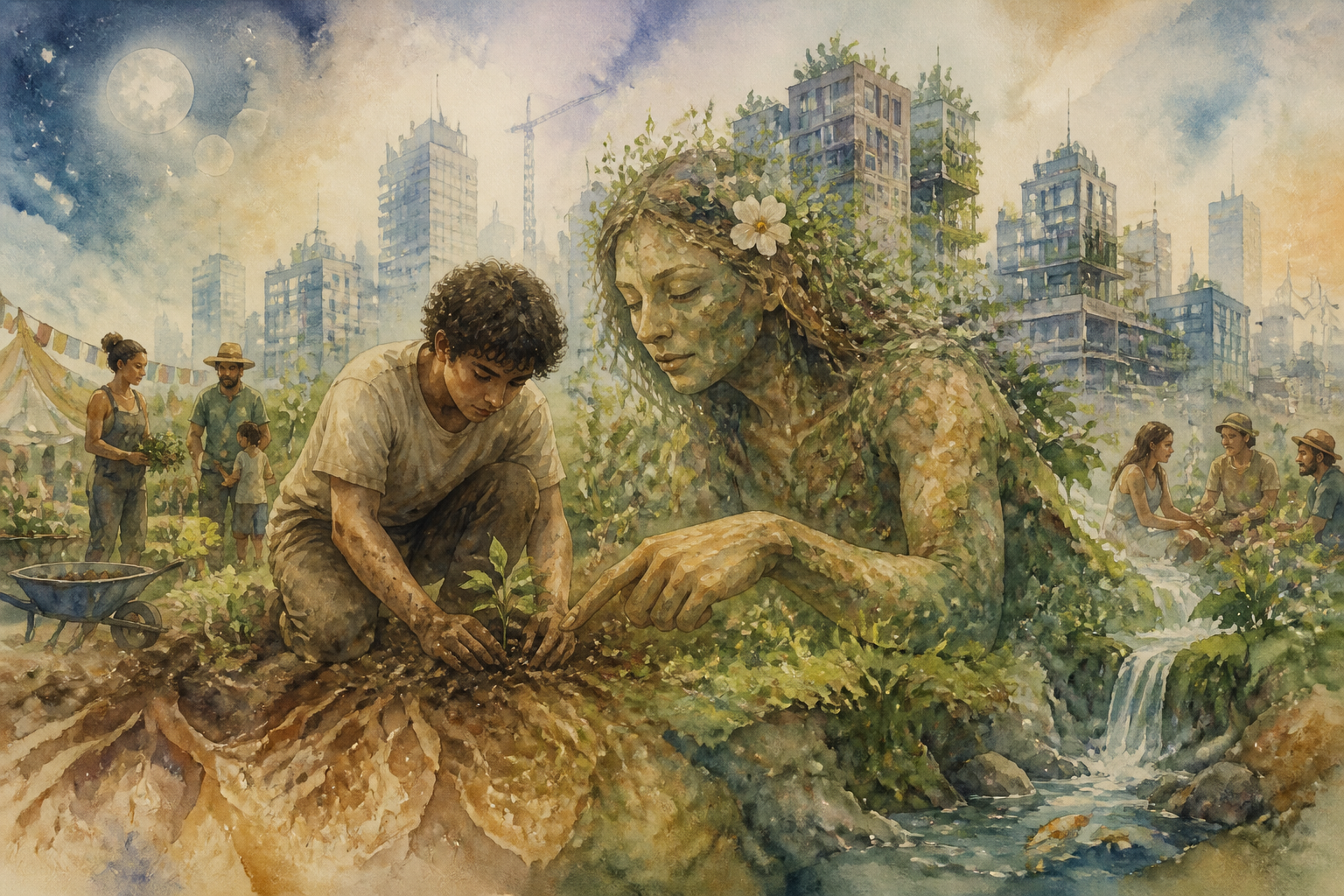
If I were young today, I would try to find some land and return to the Earth. If social systems do become unstable, land that can produce good food will be invaluable. The land is also a great teacher when we learn to cooperate with it. Work with your hands, get dirty, remain close to the Earth and create communities, because we cannot do this alone.
Many young people in the United States, Canada, the Netherlands and elsewhere in Europe are already exploring communal and self-sufficient ways of living. Some live almost entirely off-grid, producing their own electricity and maintaining their own water supplies. In a sense, this resembles what I did after the 1960s. The Vietnam War, the Soviet and nuclear threats, and the destruction of beautiful landscapes made that period seem very dark to me. We lived through those dangers, as our parents lived through two World Wars and a severe economic crisis, I am sure the present generation can also meet the challenges of its time, with, as I said before faith, relaxation, creativity, courage and endurance.
In dit artikel
Deel dit artikel
Meer lezen
Interview Elias Amidon
Interview Elias Amidon
Balans & Drempels